
E. Brooke Lanier received her MFA degree in painting from Tyler School of Art. She earned her BFA degree from the School of the Art Institute of Chicago. She has shown her work in Rome, Italy; Prague, Czech Republic; and across the United States; notably in the Smithsonian Institute’s S. Dillon Ripley Center and the John F. Kennedy Center in Washington, D.C.
exhibits and represents artists working across a variety of disciplines with particular focus on contemporary book arts, works on paper, collage and assemblage. |
910 Santa Fe, #101, Denver, Colorado, USA at the north end of the 910 Arts Complex in Denver's Art District on Santa Fe 720.282.4052 • alicia@abecedariangallery.com
|
.
| Back to Intro List of artists (alphabetized by first name) Carol Erickson Carol Es Cheryl Bailey/Deborah Henson Connie Norman Danielle Feliciano E. Brooke Lanier Elizabeth McKee Ellen Wiener Friedrich Kerksieck Heidi Zednik Jan Owen Jennifer Hines Justin Quinn Kristen Catlett Mamiko Ikeda Marí Emily Bohley Marina Soria Stephen Sidelinger Sun Young Kang Susan Kapuscinski Gaylord Turner Hilliker |
E. Brooke Lanier Philadelphia, Pennsylvania 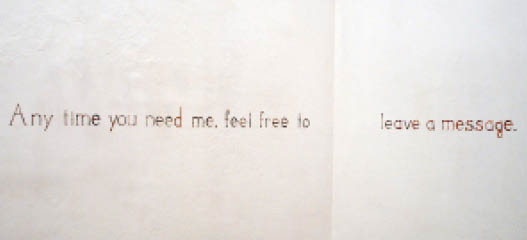 Sincerely paper, etchings dimensions variable © 2010 - $700 The foundation of this piece is an etching of the phrases, “I love you” and “I am so proud of you,” repeated so many times that they become static and semi-illegible. I designed a font, then cut the words “Any time you need me, feel free to leave a message” out of the etched paper. I intended this piece to address the disconnect between intentions and actual outcomes in relationships that often occurs among very busy people, especially with the growing number of alternative, more time-efficient methods of communication increasingly replacing actual human interaction. Repeating something endlessly sometimes nullifies its intended effect. 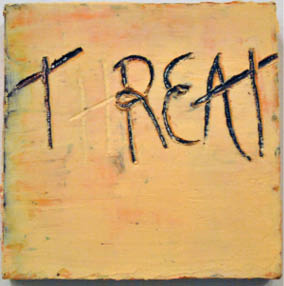 Veiled Threat Oil and wax on panel 4x4x3/4 © 2010 - $300 The small scale and pastel palette of this painting allude to domesticity and the body. The text’s veiled threat, presented as a treat, implies that subtle threats are the most dangerous. For instance, victims of domestic violence often become accustomed to navigating a complex pattern of behaviors in order to avoid incurring abuse. Things that would cause great alarm to an outsider become routine in their household. This kind of subtle threat, hidden in the promise of security, poses more risk than hitching a ride from a blood-spattered maniac for the reason that it is easier to avoid a threat that is an obvious screaming danger than one you are unaware is dangerous at all. 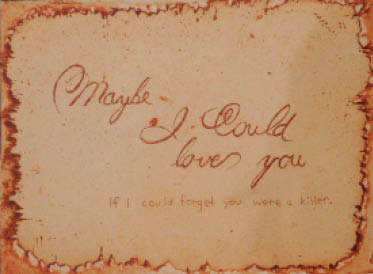 Caveat etching 73/4 x 57/8 © 2010 - $300 Some day maybe I could love you if I could forget you were a killer This piece highlights our tendency to gloss over or romanticize harsh truths and fundamental realities when they conflict with our idealized image of a person whom we find appealing. The text in this piece is the first line of a poem which addresses an emotionally and politically complex flirtation with an officer in the US Military. |